Loops
Loops allow you to repeat a section of a track seamlessly, giving you more control, creative freedom, and flexibility while mixing. Use loops to extend intros and outros, highlight a vocal hook, isolate a drum break, or build tension before a drop. Whether you're layering textures or crafting smooth transitions, loops are essential for both live performance and preparation.
Using Auto Loops
The quickest way to create loops while mixing is with Auto Loops.
- Use the arrow buttons to set your desired loop length.
- When you reach the point in the track where you want the loop to begin, click the loop button between the arrows (where the number is shown).
- The button will turn blue to show that the loop is active.
- Click it again to exit the loop.
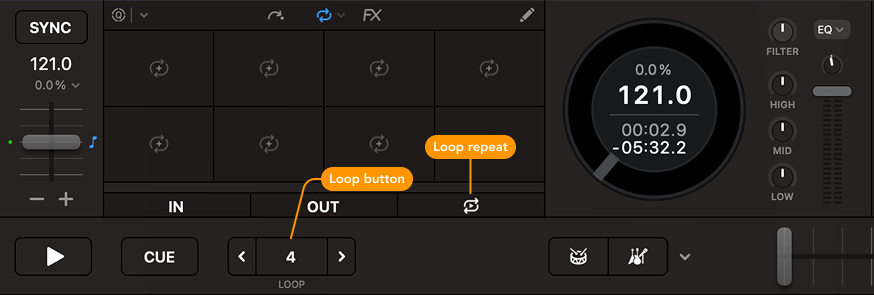
If the loop is inactive, pressing the Loop repeat button will jump back to the loop.
Loop section
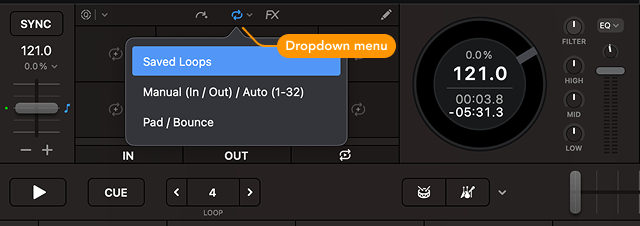
To open the Loop section, click the Tools Bar in the main toolbar and then click the dropdown menu next to where you find Cue Points.
You can choose between three options:
- Saved loops
- Manual (In / Out) / Auto (1-32)
- Pad / Bounce
Saved loops
Saved loops work just like saved cue points. Each track can store up to eight saved loops, which appear as pads in this panel. You can click a loop pad to instantly jump to that loop.
- Loops will appear in blue and named if previously saved.
- To remove a loop, click the Edit button (pencil icon), then click the X on the pad.
You can reorder your saved loops by clicking and dragging the six dots on the right side of each pad.
You can also rename saved loops, just like cue points—handy for labeling breakdowns, build-ups, or your favorite mix moments.
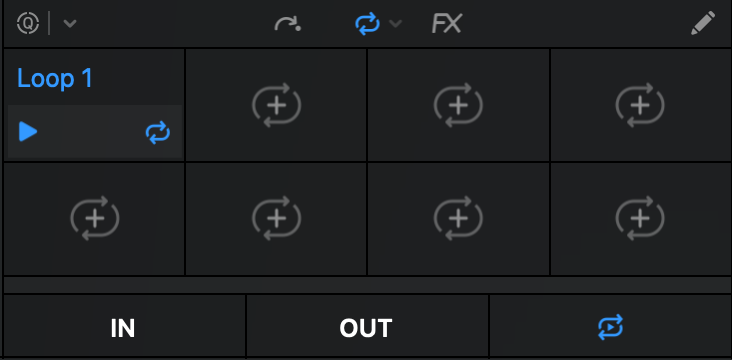
To activate a loop without jumping to it, click the loop icon on the pad. Clicking anywhere else will jump to the loop directly.
Quantizing loops
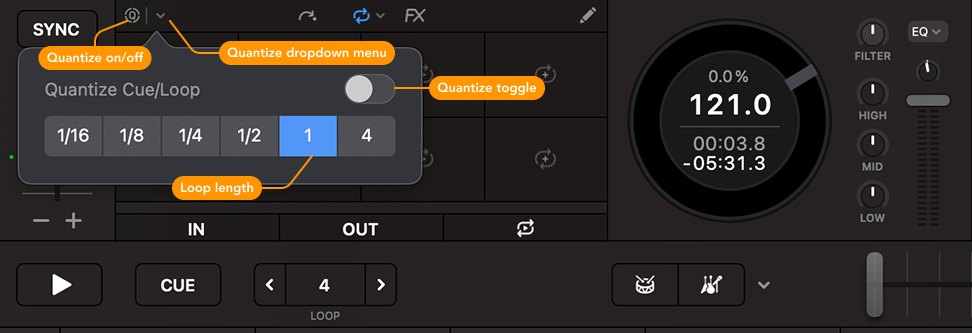
You can also enable Quantize to keep loops locked to the beat. Toggle the Quantize switch, then choose a snap value: 1/16, 1/8, 1/4, 1/2, 1 beat, or 4 beats.
Manual (In/Out) / Auto (1-32)
Manual looping gives you full control over where a loop starts and ends—ideal for developing tight timing and beat-matching skills.
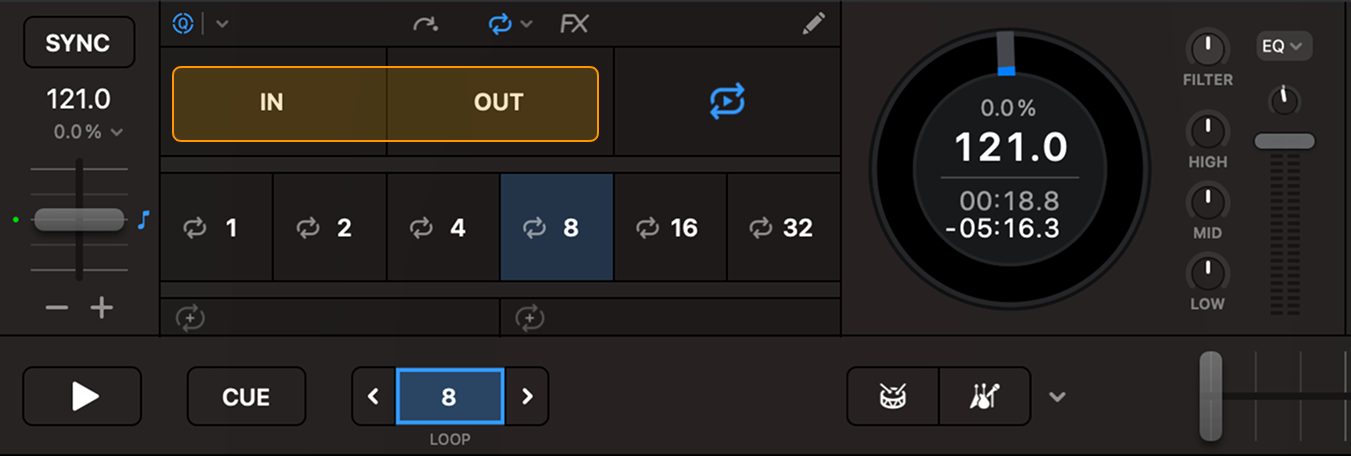
- Click Loop In to set the start point.
- Click Loop Out to set the endpoint.
- Use the Auto (1-32) loop length buttons (1, 2, 4, 8, 16, 32) to extend or reduce the loop.
Click the highlighted loop button to deactivate the loop. You can also enable Quantize for tighter beat sync.
Pad / Bounce
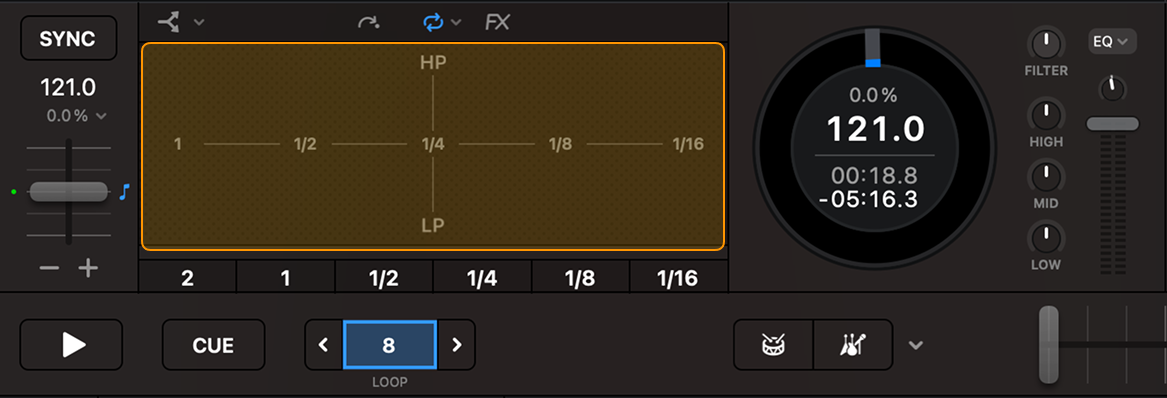
Bounce Pads let you trigger short, rhythmic loops that "bounce" in time with the beat—perfect for adding stutter effects, fills, or tension before a drop.
- Six pads are available, with loop lengths ranging from 2 beats to 1/16 beat.
- Click and hold a pad to trigger the loop. Release it to return to normal playback.
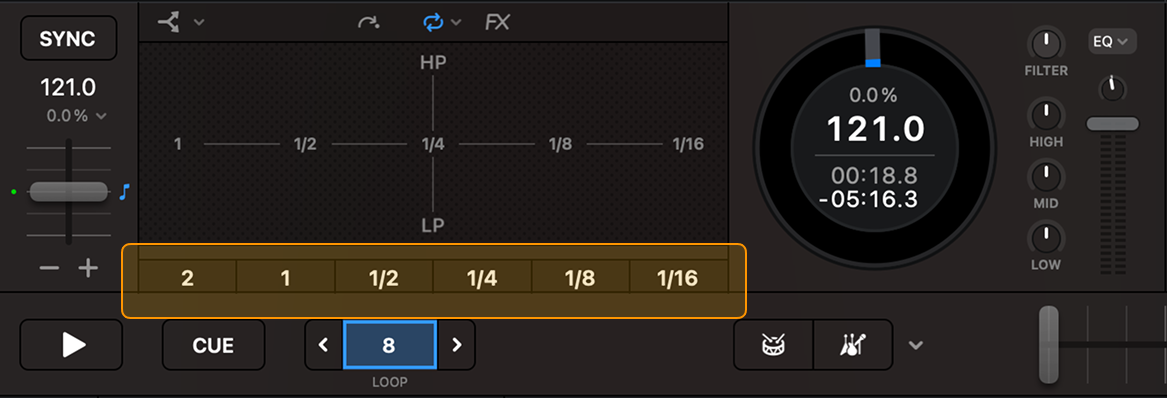
Use Bounce Pads for beat rolls or glitch effects to create build-up before a drop or breakdown.
Routing Bounce Pads
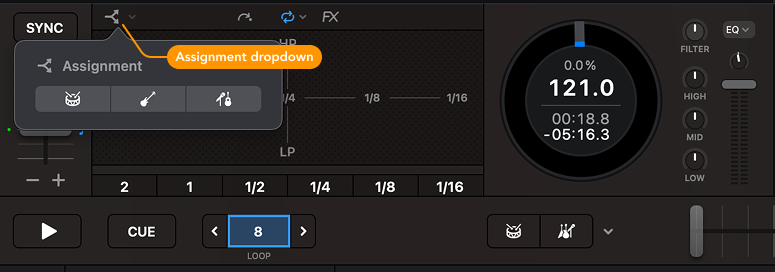
You can also route Bounce Pads to individual elements of the track using Neural Mix™.
- Click the FX routing dropdown menu to assign to the vocals, harmonics, or drums.
- Choose routing modes such as vocals/harmonics/drums or melodic/bass/drums via the Neural Mix™ toolbar.
You can also trigger the X/Y Pad using your trackpad or mouse to combine manual loop lengths with a high-pass or low-pass filter for added texture.
Go to the Effects section to learn more about filters and other effects.